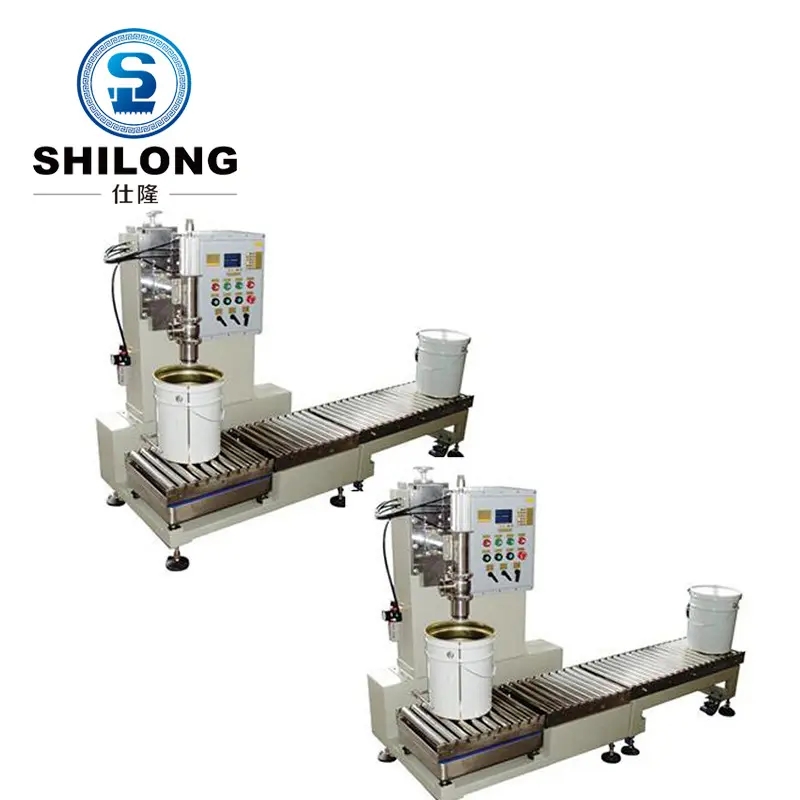
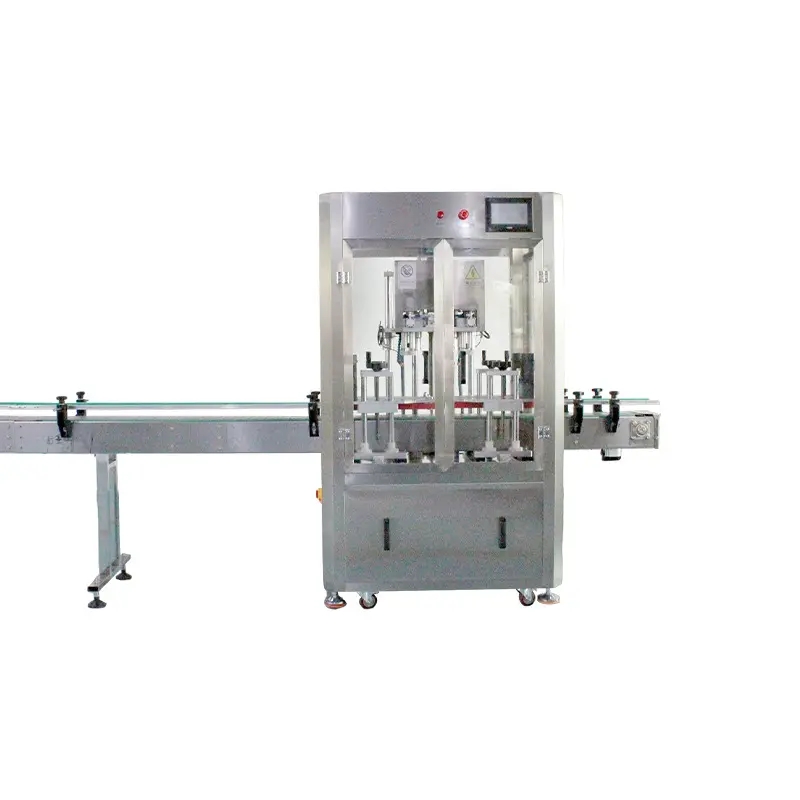
Working Principle of Semi-Automatic Piston Paste Filling Machine
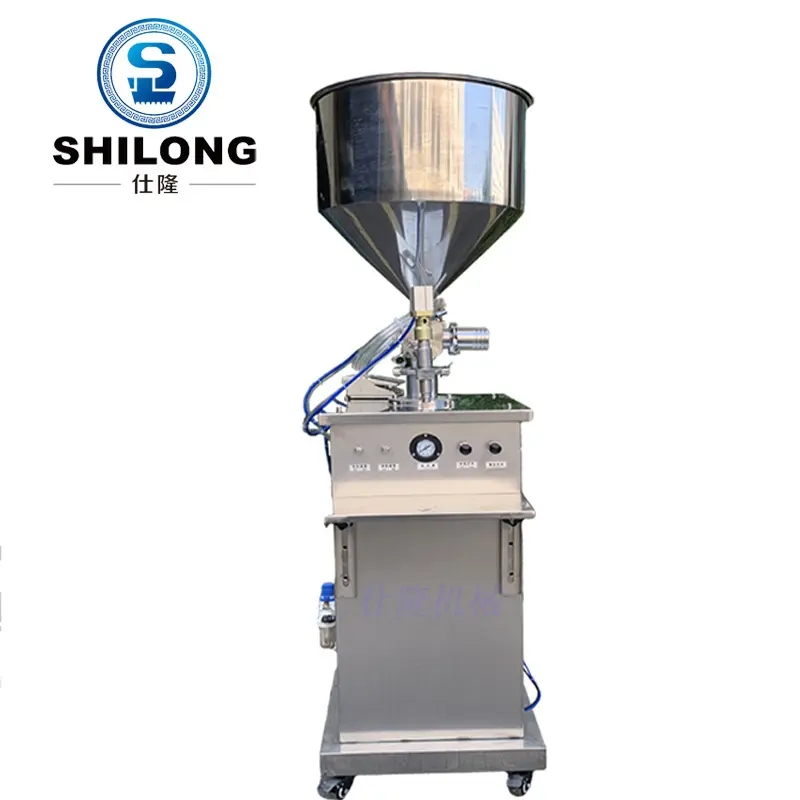
As a professional manufacturer & factory from China, Shilong Machinery supplies semi-automatic piston paste filling machines. This pneumatic piston metering type is widely adopted in the market. Driven by an air cylinder, the piston works together with a one-way rotary valve (3-way valve) to complete two cycles: material suction and discharging. Operators place containers manually, and a foot switch serves as the trigger signal to finish one-time quantitative filling.
Main Components:
Hopper, 3-way rotary valve, metering cylinder, piston, driving air cylinder, reed stroke adjustment switch, foot valve, air source treatment unit, filling nozzle.
I. Functions of Core Components
1. Hopper: Stores paste materials. The paste flows into the 3-way valve by gravity. Stirring or heating functions are optional to prevent paste sedimentation and solidification.
2. 3-way Rotary Valve (Rotary One-way Valve): The channel switch for metering. It has two working positions:
3. Metering Cylinder & Piston: Core for quantitative filling. The volume is determined by the piston travel distance inside the cylinder. Longer travel means larger filling volume.
4. Driving Air Cylinder: Powered by compressed air, it drives the piston to reciprocate back and forth, and mechanically links the 3-way rotary valve to switch channels synchronously.
5. Reed Induction Switch: Mounted on the outer wall of the air cylinder to limit the maximum backward travel of the piston. Adjusting the switch position changes the piston stroke, thereby adjusting filling volume.
6. Foot Valve: Human-machine trigger component. When pressed by the operator, it sends a pneumatic signal to start a full suction and filling cycle.
7. Air Source Treatment Unit: Regulates pressure and filters oil and water. It stabilizes compressed air at 0.4~0.6MPa to guarantee stable metering.
II. Complete Working Cycle (One Filling Process in Two Stages)
Stage 1: Material Suction (Piston Retraction)
When the foot switch is pressed, the pneumatic signal activates the cylinder and pulls the piston backward. Meanwhile, the 3-way rotary valve switches to the suction position.
- Channel status: Hopper connects to the metering cylinder; the filling nozzle channel is closed.
- The backward movement of the piston creates negative pressure inside the metering cylinder. Paste from the hopper is drawn into the metering cylinder under gravity and negative pressure.
- The piston retracts until it hits the reed switch and stops automatically. A fixed volume of paste is sucked into the metering cylinder, preset by piston stroke.
Key point: The filling nozzle stays closed during suction to avoid dripping.
- The piston squeezes paste inside the metering cylinder. Positive pressure pushes paste out through the filling nozzle into the container below.
- The piston reaches the front end, pushing stops, and one filling cycle completes.
Release the foot pedal and wait for the next trigger to repeat the whole cycle.
Key linkage: The piston and 3-way rotary valve are mechanically linked. Valve switching is synchronized with piston movement to avoid material backflow and suction, which forms the foundation of piston metering.
III. Auxiliary Anti-dripping & Anti-stringing Principle
Pastes such as cream, ointment and sauce tend to form material strings and drip after cutoff. The machine can be equipped with lifting filling nozzle and suck-back function:
At the instant filling finishes, the piston performs a slight backward suck-back to generate temporary negative pressure inside the nozzle. This pulls residual paste back inside the nozzle to prevent dripping on bottle bodies. For high-viscosity paste, a conical shut-off head is added to cut material strings.
IV. Principle of Filling Accuracy Control
1. Volumetric Metering: A fixed piston stroke produces a fixed volume. It belongs to volumetric metering.
2. Adjustment Method: Move the reed switch on the cylinder to change the piston retraction distance → change the sucked material volume.
3. Weighing Calibration: The machine adjusts volume while pastes have different densities. Before production, use an electronic scale to convert volume into weight and fine-tune stroke to reach target filling weight.
Note: This machine measures volume. If material density changes with temperature or air bubbles, weight errors will occur.
V. Pneumatic Circuit Logic
Air compressor → Air source treatment unit (pressure regulation & water filtering) → Pneumatic foot valve → Air distribution circuit → Main cylinder
Pneumatic signals control cylinder reciprocation. Mechanical connecting rods of the cylinder drive synchronous reversing of the 3-way rotary valve for continuous operation. The whole machine is mainly pneumatic. 220V power is only for indicator lights (fully pneumatic versions require no electrical circuits).
VI. Limitations in Working Principle
1. As volumetric metering equipment, air trapped inside materials reduces the actual weight for the same volume.
2. Seals are elastic consumables. Long-term wear creates gaps, causing air leakage, material cross-flow and inaccurate metering during suction.
3. Paste is non-Newtonian fluid. Viscosity variation changes flow resistance and discharging speed, leading to minor measurement errors.
4. Air pressure fluctuation causes unstable cylinder thrust and inconsistent piston speed, affecting filling results.
We are a professional factory, manufacturer and supplier of packaging machinery located in China. Our company integrates research, design, development and manufacturing. Committed to introducing advanced technologies and integrating premium resources, we deliver customized packaging equipment with reliable quality, abundant technical experience and full-range professional service.
We maintain high production efficiency and own a complete system covering R&D, production, sales and after-sales service.
We specialize in developing and producing packaging equipment: bottle washers, capping machines, labeling machines, sleeve labeling machines, sealing machines, emulsifiers, mixing tanks, water treatment systems, and custom semi-automatic & automatic filling production lines, alongside other food packaging machinery.
Quality and reputation are our core principles. As your trusted supplier in China, we provide personalized products and comprehensive after-sales support for all clients.
We use cookies to offer you a better browsing experience, analyze site traffic and personalize content. By using this site, you agree to our use of cookies. Privacy Policy