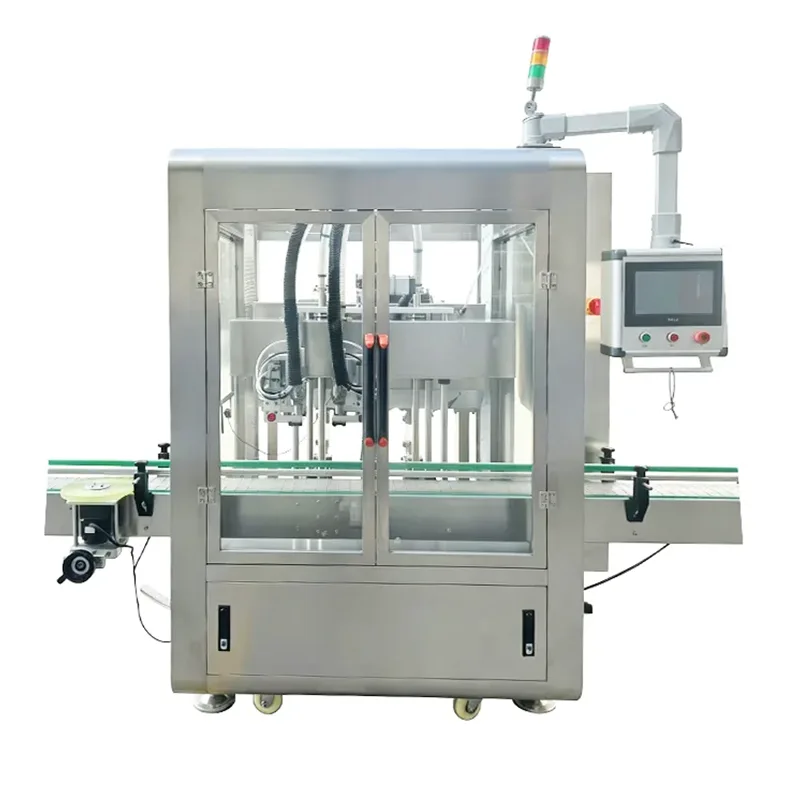
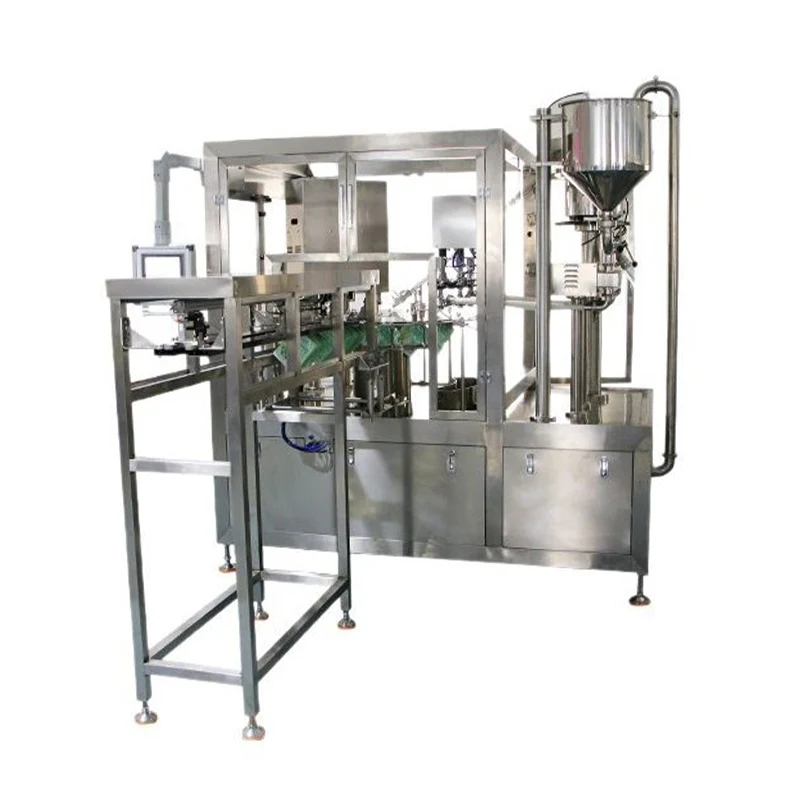
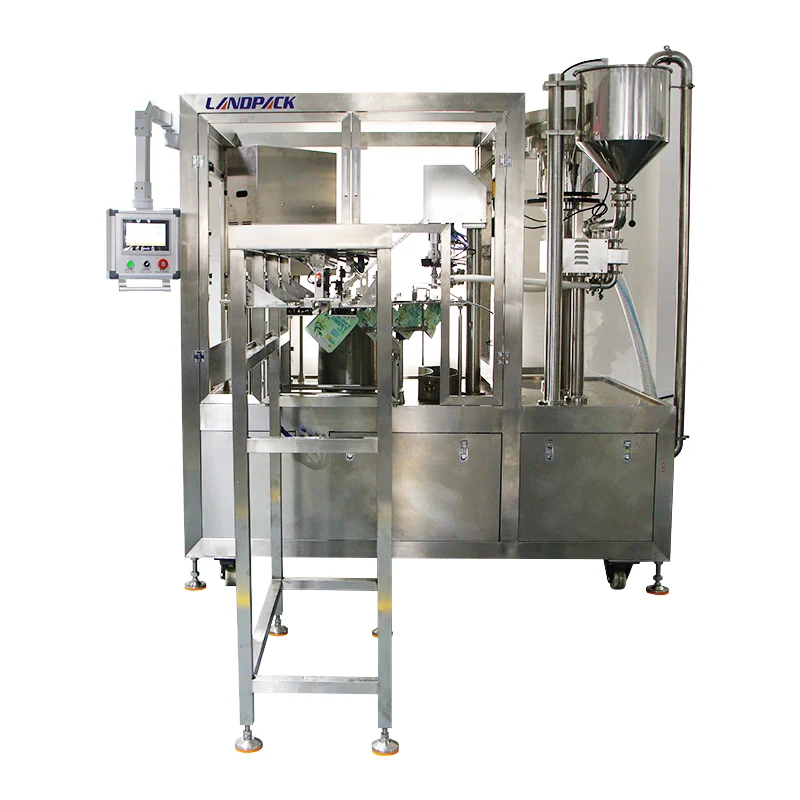
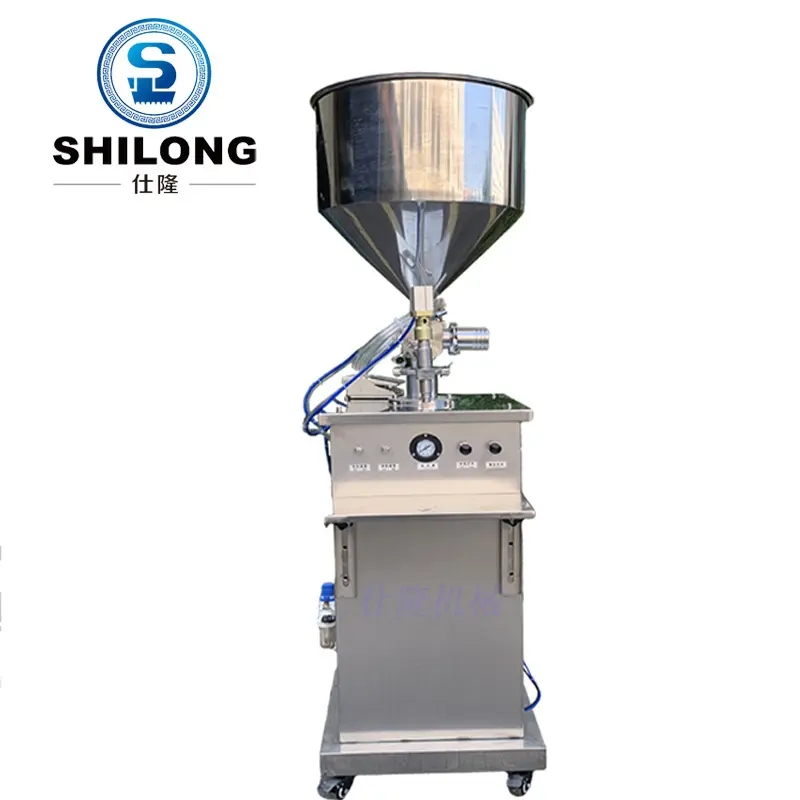
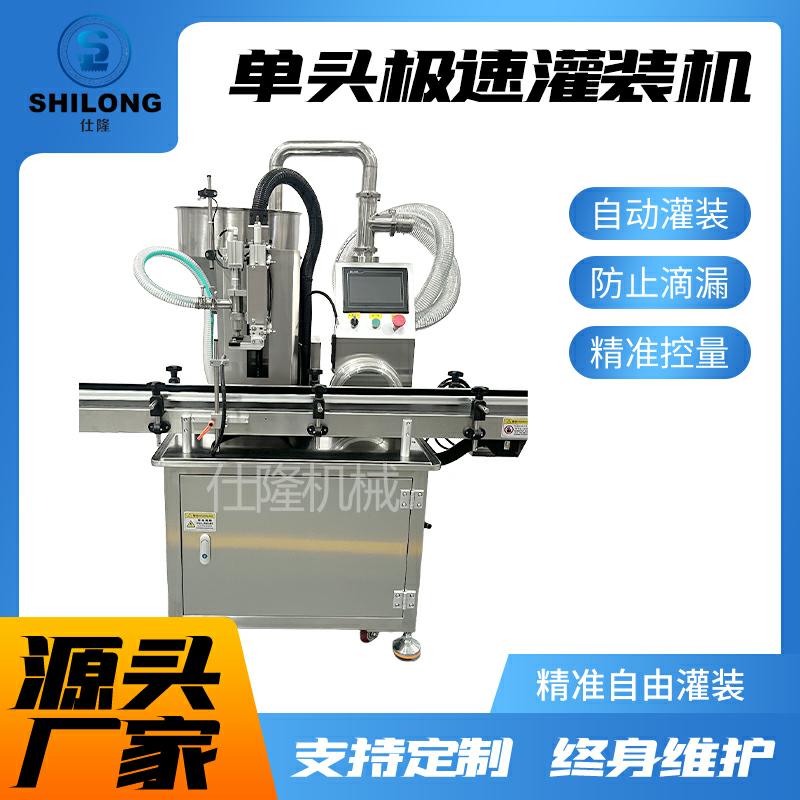
Full Name:Dual‑Servo Dual‑Head Follow‑Type Filling Machine
Core Technology: Electronic cam dynamic follow‑up. Bottles keep running on the conveyor without stopping or blocking. Filling heads travel at the same speed as bottles and complete filling dynamically, which differentiates it from conventional fixed‑position stop‑and‑fill fillers.
All material‑contact wetted parts are made of 304 / 316 stainless steel. Suitable for liquids & medium‑viscosity materials such as daily‑chemical products, edible oil, disinfectants, creams & lotions.
I. Breakdown of Five Main Mechanical Modules
1. Conveying & Bottle‑Separating Mechanism
Main Conveyor: Variable‑frequency / servo‑driven flat belt. Main‑shaft encoder captures real‑time conveyor position, acting as the reference spindle for the whole follow‑up system.
Bottle‑separating Assembly: Limit guardrails, side guides, bottle‑separating cylinder. Function: maintain fixed pitch between bottles.
Key Point: Tracking filling machines require a minimum bottle‑to‑bottle pitch. Too small pitch will cause physical interference between two filling heads; the system will switch to alternate‑mode operation automatically.
Two fully‑independent X‑axis horizontal servo modules with zero mutual interference.
Drive: Servo motor + precision ball screw + linear guide rail.
Travel Range: Tracking stroke + return stroke.
Each head is equipped with independent Y‑axis lifting cylinder / servo drive for nozzle elevation, enabling submerged low‑level filling & fill‑while‑rising function to suppress foaming and splashing.
Mechanical Limit: Dual protection by hardware hard‑stop limit and software limit to prevent over‑travel collision.
Motion Profile: Stand‑by position → accelerate to catch‑up bottle → synchronous zone running at conveyor speed (filling executed) → decelerate & disengage → high‑speed return to stand‑by position, cycle repeatedly.
3. Dual‑Head Independent Metering & Filling Unit (Core for Material Dosing)
Metering of two filling heads is fully independent. Supports dual‑head parallel operation or single‑head‑only operation with one head disabled.
Three mainstream metering solutions:
1. Servo gear pump (magnetic gear pump)
For low‑to‑medium viscosity: liquid detergent, disinfectant, lubricant, edible oil. Volume is controlled by servo‑driven gear rotation cycles. Accuracy: ±0.5%‑1%. Viscosity & temperature fluctuation may slightly affect metering; temperature‑compensation module is recommended for oil‑based materials.
2. Servo piston metering
For high‑viscosity materials: honey, cream, paste sauce. Positive‑displacement dosing; filling volume determined by piston stroke. Accuracy: ±0.3‑0.5%. Seals are consumable parts requiring periodic replacement.
3. Flowmeter metering (turbine / mass flowmeter)
For high‑volume water‑based liquids & oils. Closed‑loop control via real‑time flow signal acquisition. High accuracy. Sensitive to material bubbles and impurities; higher investment cost.
Standard nozzle assembly: Anti‑drip suck‑back valve. Instant suck‑back upon filling completion to eliminate hanging‑drop and dripping. Blow‑anti‑sticking function optional.
4. Material Circuit System
Material hopper, feeding pump, material pipelines, filter. Optional CIP cleaning port for pipeline flushing without disassembly.
Conveyor serves as master axis; two filling‑head X‑axes act as two independent slave axes via electronic‑cam coupling control, no mechanical cam hardware required.
Full timing sequence:
1. Bottles flow along conveyor; photoelectric sensor latches current encoder position when bottle mouth is detected.
2. PLC continuously reads real‑time encoder position of conveyor. When conveyor travel distance equals physical offset from sensor to filling station, cam coupling is triggered.
3. X‑axis servo accelerates and matches conveyor speed to enter synchronous‑tracking zone; filling head keeps static relative to moving bottle.
4. Y‑axis descends; metering pump starts. Two‑speed filling implemented: fast fill → slow fill to avoid foaming and overflow.
5. When target volume is reached, pump stops; anti‑drip valve executes suck‑back; Y‑axis lifts.
6. Disengage cam synchronization; X‑axis returns rapidly to initial stand‑by position, latch cleared and wait for next trigger.
7. Dual‑head logic: Odd‑sequence bottles filled by Head‑1; even‑sequence bottles filled by Head‑2. Parallel dual‑bottle filling when bottle pitch is sufficient; auto staggered alternate filling when pitch is insufficient.
Key Performance Index: Tracking synchronization error controlled within ±0.3 mm, ensuring precise nozzle‑to‑bottle‑mouth alignment without spillage.
Touch‑Screen Functions
Multi‑product recipe storage for one‑click recall during format changeover.
All parameters configurable on HMI: filling volume, fast‑slow fill switch‑point, tracking speed, stand‑by position, lifting height.
Production counter, fault alarm history.
Single‑head enable / disable toggle.
III. Complete Equipment Operation Workflow
1. Power‑on homing: All servo axes return to mechanical origin.
2. Conveyor starts; material is fed to feeding pump.
3. Empty bottles continuously feed into conveyor line.
4. Photoelectric sensor detects bottles and latches position signal.
Sufficient bottle pitch. Head‑1 and Head‑2 follow and fill two separate bottles concurrently for maximum throughput.
2. Alternate Mode (Staggered filling)
Small bottle‑to‑bottle pitch. Two heads work in staggered timing: one completes filling & returns before the other starts tracking, to avoid mechanical interference.
Guangzhou Shilong Machinery Equipment Co., Ltd. is a professional packaging machinery manufacturer integrating research, design, development and manufacturing. We absorb advanced technologies, integrate superior resources, and deliver tailor‑made packaging equipment with reliable machines, rich industry experience and professional services.
We maintain a complete system covering R&D, manufacturing, sales and after‑sales service. Our product portfolio includes packaging machinery such as bottle washing machines, capping machines, labeling machines, sleeve labeling machines, sealing machines, emulsifiers / mixing kettles and water‑treatment systems. Custom‑built full‑auto & semi‑auto filling production lines are available for food‑processing & packaging industries.
Quality assurance, high‑credibility and dedicated service are our persistent corporate principles. We provide customized products and comprehensive all‑round services for global customers.
We use cookies to offer you a better browsing experience, analyze site traffic and personalize content. By using this site, you agree to our use of cookies. Privacy Policy